
Key Takeaways
- Magnetism is one of the most common and least understood causes of timekeeping problems in mechanical watches.
- Everyday objects including smartphone cases, bag clasps, tablet covers, and laptop speakers can generate magnetic fields strong enough to affect a watch movement.
- The most common symptom of a magnetised watch is sudden, significant timekeeping gain - often running several minutes fast per day.
- Demagnetising a watch is a straightforward process for a qualified watchmaker and does not require disassembly.
- Modern anti-magnetic watches use non-ferrous movement components or soft iron inner cases to resist magnetic interference.
- Prevention through aware, considered habits is more practical than relying on any single design feature.
- Proper storage away from magnetic sources is an underappreciated but effective part of long-term watch protection.
Most watch collectors know to avoid dropping their pieces, keep them away from water beyond their rated depth, and store them thoughtfully when not being worn. Magnetism tends to get less attention, which is unfortunate, because it is one of the more common causes of sudden, unexplained timekeeping problems in mechanical watches - and one of the easier threats to guard against once you understand it.
At Lux Watch Care, we talk regularly with Australian collectors who are puzzled by a watch that was keeping excellent time and then suddenly started running minutes fast with no obvious cause. In many of these cases, the explanation is magnetism. This post explains why it happens, which objects are the most common culprits in everyday life, how to spot the signs, what to do if your watch has been affected, and how to store and use your watches in a way that reduces the risk going forward.
Why Mechanical Watches Are Vulnerable to Magnetic Fields
The timekeeping heart of a mechanical watch is the escapement, and specifically the balance wheel and hairspring assembly. The hairspring is an extremely fine coil of metal that oscillates back and forth at a precise frequency, regulating the release of energy from the mainspring through the gear train. In a standard mechanical movement, the hairspring is made from a ferrous (iron-containing) alloy, which makes it susceptible to magnetic fields.

When a ferrous hairspring is exposed to a strong enough magnetic field, the individual coils can become attracted to each other. If adjacent coils stick together, even partially, the effective length of the spring changes. Because the oscillation frequency of the balance wheel is determined by the spring's length and tension, any change to those properties alters the rate at which the movement runs. The result is typically a watch that gains time - sometimes dramatically, by several minutes per day.
The key point is that this can happen without the watch going anywhere near an obviously powerful magnet. The magnetic fields generated by modern consumer electronics are often sufficient to affect a standard movement under the right conditions.
Everyday Sources of Magnetic Fields
The magnetic sources most likely to affect a watch are not industrial magnets or MRI machines - they are the objects sitting in your pocket, bag, and on your desk.
Smartphone cases with magnetic clasps are a particularly common culprit. Many folio-style cases use small but potent magnets to hold the cover closed or to enable wireless charging alignment. Placing your watch in the same pocket as a phone in one of these cases creates a meaningful exposure risk, particularly if they are in contact for extended periods.
Tablet covers and keyboard folios often use the same magnetic closure mechanisms, and the magnets involved are sometimes quite strong. Placing a watch face-down on a closed tablet cover is a situation worth avoiding.
Laptop speakers contain magnets as part of their design. The underside of many laptops, particularly near the speaker grilles, can produce localised magnetic fields. Resting a watch next to or on a laptop is a common habit that carries more risk than most people realise.
Handbag and briefcase clasps, particularly on premium leather goods, frequently use magnetic fasteners. If a watch sits in the same compartment as one of these clasps, or is set down on a bag that is clasped, the exposure can add up over time.
Other common sources include electric motors in household appliances, induction cooktops (near the surface, when active), audio equipment including headphones left on a desk or surface, and some hotel room key card holders. The fields produced by any single encounter may be modest, but repeated exposure to multiple sources over time can have a cumulative effect.
How to Tell If Your Watch Has Been Magnetised
The most telling sign is a sudden change in timekeeping rate, particularly gaining time at a noticeably faster rate than usual. A watch that was keeping time within a few seconds per day and is suddenly gaining two or three minutes per day, without any obvious physical event to explain it, is a strong candidate for magnetisation.
You can test this yourself using a simple compass or a dedicated watch magnetism testing app on your smartphone. Hold the compass near different parts of the watch case - if the compass needle deflects, the watch case or movement has picked up a magnetic charge. Smartphone apps that use the device's magnetometer can serve the same function, though a physical compass is often more reliable.
It is worth noting that not all timekeeping inaccuracy is caused by magnetism. If your watch is running consistently slow, or if the variation in timekeeping is irregular rather than a consistent gain, other causes may be at play and a watchmaker should assess the movement directly. Our post on what long-term accuracy looks like in a well-maintained automatic watch provides useful context around what normal and abnormal rate behaviour looks like across different movement types.
What to Do If Your Watch Is Magnetised
The good news is that demagnetising a mechanical watch is a relatively simple and inexpensive procedure for a qualified watchmaker. Using a demagnetiser - a device that passes the watch through a diminishing alternating magnetic field - the watchmaker can neutralise the residual magnetism in the movement components without opening the case or disassembling anything.
In most cases, demagnetising restores normal timekeeping immediately. If the watch has been magnetised significantly and over a prolonged period, there may be a small adjustment to the regulation required afterwards, but this is straightforward work.
Do not attempt to demagnetise a watch yourself using consumer-grade demagnetisers designed for other purposes, as these can produce unpredictable fields that may make the situation worse. A watchmaker with a purpose-built watch demagnetiser is the appropriate path.
If your watch has been significantly magnetised and you notice any mechanical symptoms beyond timekeeping irregularity - such as the crown feeling different, or any audible change in the movement - have a watchmaker inspect it rather than attempting to continue using it and hoping the problem resolves.
Anti-Magnetic Watches: What the Specifications Actually Mean
Many modern watches, particularly sports and professional models, are described as anti-magnetic. Understanding what this means in practice helps set appropriate expectations.
The standard commonly referenced is ISO 764, which defines a watch as anti-magnetic if it can withstand a direct field of 4,800 A/m (amperes per metre) and continue running within specified accuracy limits. This is a meaningful level of resistance for most everyday scenarios, but it is not unlimited protection against all magnetic sources.
Some watches use a soft iron inner case surrounding the movement. This acts as a magnetic shield, absorbing and deflecting external fields before they can reach the movement components. The case itself becomes magnetised rather than the movement, and the movement continues to function correctly. This approach, used historically by manufacturers including IWC and others, is highly effective but adds to the overall thickness of the watch.
A newer approach, used by some manufacturers, is to replace ferrous movement components - particularly the hairspring - with non-ferrous materials such as silicon or certain nickel-phosphorus alloys. These materials are inherently non-magnetic, so there is nothing in the movement that can become magnetised in the first place. Silicon hairsprings are used in some contemporary movements and offer magnetism resistance alongside other beneficial properties.
For most collectors, a watch marked as anti-magnetic to ISO 764 provides practical protection against the everyday magnetic sources described earlier. Being thoughtful about placement and storage remains worthwhile regardless of the watch's specifications.
Practical Habits That Reduce Risk
The most effective protection against magnetism is a combination of awareness and deliberate habit. None of the following requires significant effort, but together they meaningfully reduce the exposure risk for your watches.
Avoid carrying your watch in the same pocket as your phone, particularly if the phone is in a magnetic case. A watch worn on the wrist is less exposed than one tucked in a pocket beside electronics.
When placing your watch down during the day - on a desk, beside a laptop, or near audio equipment - give it a small amount of clearance from anything electronic. A few centimetres of separation reduces field exposure considerably compared with direct contact.
Be conscious of where your watch sits in relation to bag clasps and fasteners. If your bag uses magnetic closures, store the watch in a different compartment or in a dedicated watch pouch when it is not on your wrist.
At home, keep stored watches away from speakers, televisions, and similar electronics. A watch box or storage case on a shelf away from entertainment equipment is a better location than a dresser top immediately beside a speaker dock or charging pad.
How Storage Choices Affect Magnetic Exposure
Where and how you store your watches when not wearing them is a practical lever you have direct control over. A quality watch box placed on a solid surface away from electronics provides both physical protection and a degree of distance from everyday magnetic sources.
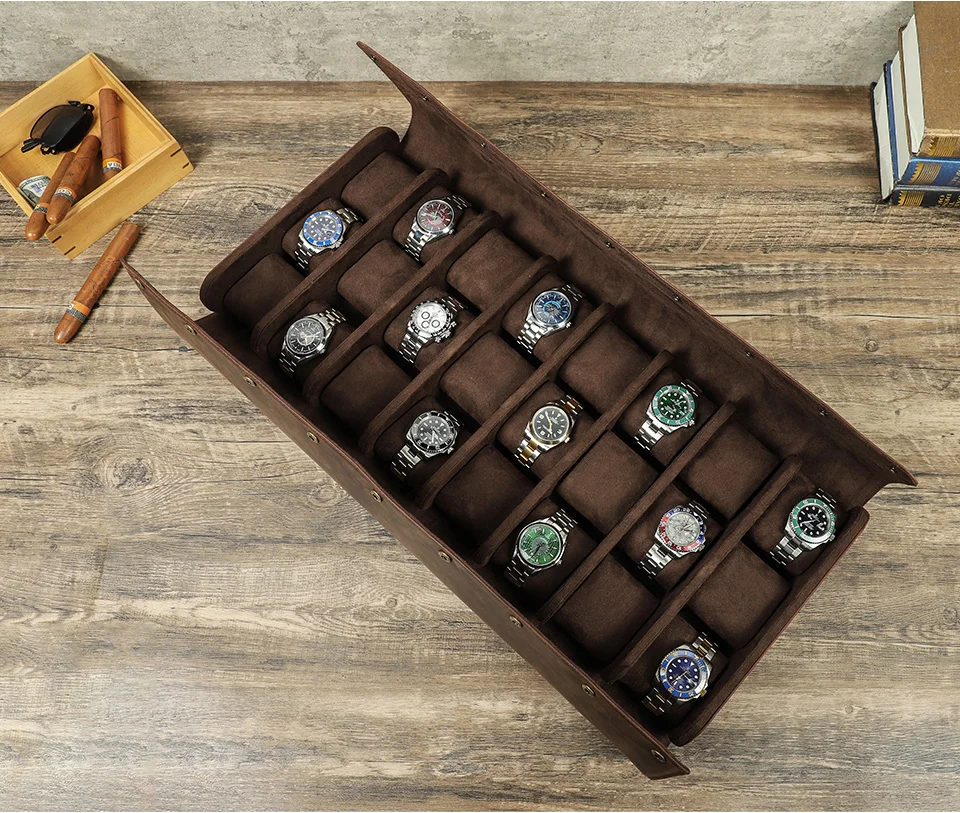
Lux Watch Care stocks a range of premium watch boxes for home storage that provide considered protection for individual pieces and collections alike. For collectors who travel and need to keep watches secure and separated from bag contents - including magnetic clasps - our leather watch rolls and travel cases offer a structured, padded solution that keeps watches isolated from the surrounding contents of a bag.
For a single watch kept at home, the vintage cowhide leather single slot watch case provides individual protection in a compact format. For those managing multiple pieces, the genuine leather 8 slot watch storage box keeps a collection organised and away from incidental contact with electronics. If you travel frequently and want portable, dedicated protection for one or two pieces, the genuine leather 2 slot watch case keeps watches separated and padded within a bag.
Our post on protecting watches from physical and environmental damage during daily use covers broader protection considerations that complement the specific magnetism guidance in this post. For collectors keeping watches in storage between wears, our overview of how to store automatic watches properly when not in use addresses the full range of storage considerations including environment, humidity, and positioning.
The Broader Point About Watch Care
Magnetism is a good example of a watch care topic that rewards a small investment of knowledge and attention. It is not a dramatic or particularly complicated threat, but it goes unrecognised often enough that many collectors experience its effects without understanding the cause.
At Lux Watch Care, our view is that caring for a collection well means understanding the range of factors that affect watch condition - not just the obvious physical ones. Magnetism sits alongside humidity, dust, physical shock, and improper storage as a practical consideration that collectors at any level benefit from understanding.
If you have questions about watch storage, care accessories, or anything related to keeping your collection in excellent condition, we are happy to help.
Reach out to the Lux Watch Care team here
Frequently Asked Questions
Can a smartphone magnetise a mechanical watch?
Yes, under certain conditions. Smartphones themselves generate relatively low magnetic fields during normal operation, but smartphone accessories - particularly magnetic folio cases and cases designed for wireless charging alignment - can contain small but potent magnets. Sustained close contact between a mechanical watch and a phone in one of these cases carries a meaningful risk of magnetising ferrous movement components, particularly the hairspring.
How do I know if my watch is magnetised?
The most common sign is a sudden, significant increase in timekeeping rate - the watch running several minutes fast per day when it was previously accurate. You can test for magnetism using a compass: if the needle deflects when held near the watch, the case or movement has picked up a magnetic charge. Smartphone magnetometer apps can also be used for a rough test, though a physical compass is often more reliable.
Is demagnetising a watch expensive?
Demagnetising is generally one of the less costly watchmaker services. The process does not require disassembly and typically takes only a few minutes using a purpose-built demagnetiser. The exact cost varies by watchmaker and location, but it is considerably less than a full service. If your watch is running significantly fast with no other explanation, this should be the first thing to have checked.
What does anti-magnetic mean on a watch?
A watch described as anti-magnetic to ISO 764 has been tested to withstand a direct magnetic field of 4,800 A/m while continuing to run within specified accuracy limits. This covers most everyday magnetic sources, including consumer electronics. Some watches achieve this through a soft iron inner case that shields the movement, while others use non-ferrous components such as silicon hairsprings that cannot become magnetised. Neither approach provides unlimited protection against all magnetic fields.
Can magnetism permanently damage a mechanical watch?
In most cases, the effects of magnetism are reversible through demagnetisation. However, if a watch has been heavily magnetised over a prolonged period, there is a risk of more persistent effects on the hairspring. Very severe cases can cause a hairspring to deform rather than simply magnetise, which would require replacement. This is uncommon but underscores the value of addressing magnetism promptly rather than leaving it unresolved.
What everyday objects are most likely to magnetise a watch?
The most commonly encountered sources include magnetic smartphone cases, tablet and laptop folio covers with magnetic clasps, laptop speakers, handbag and briefcase magnetic fasteners, induction cooktop surfaces when active, and desktop audio equipment. Prolonged or repeated exposure to any of these sources carries more risk than a brief, incidental encounter.
Does storing a watch near a watch winder affect magnetism?
Standard watch winders use small electric motors that generate localised magnetic fields. High-quality winders are designed to minimise this effect, and the distance between the motor and the watch cradle in a well-designed unit is typically sufficient to prevent meaningful exposure. However, placing a watch in direct contact with the motor housing of any winder - including during setup or adjustment - is worth avoiding as a general precaution.