
If you own — or are planning to own — an automatic watch, you’ve probably heard people talk about watch winders. Some collectors swear by them, others feel unsure, and beginners are often left wondering: what exactly does a watch winder do, and how does it work?
This in-depth beginner’s guide explains how watch winders work, why they exist, how they interact with automatic watch movements, and how to choose the right one — especially for Australian conditions and lifestyles. By the end, you’ll understand exactly when a watch winder makes sense and how to use one properly.
1. What Is a Watch Winder?
A watch winder is a motorised device designed to gently rotate an automatic (self-winding) watch when it’s not being worn. This rotation mimics the natural movement of your wrist, keeping the watch running and preventing it from stopping.
Watch winders are not required for quartz watches and are unnecessary for purely manual-wind watches. Their purpose is very specific:
👉 to maintain power in automatic mechanical movements.
2. How Automatic Watches Work (The Foundation)
To understand watch winders, you first need to understand how an automatic watch works.
Inside an automatic watch is a semi-circular metal weight called a rotor.
-
As you move your wrist, the rotor swings freely
-
That movement winds the mainspring
-
The mainspring stores energy
-
Stored energy powers the watch movement
When worn daily, this process happens naturally. When left unworn for 1–3 days (depending on power reserve), the watch runs out of energy and stops.
This is where a watch winder comes in.
3. How Watch Winders Actually Work
A watch winder works by slowly rotating the watch in controlled cycles, allowing gravity to move the rotor just as your wrist would.
The basic process:
-
The watch is secured around a cushion
-
A quiet motor rotates the holder
-
Rotation causes the rotor to swing
-
Rotor winds the mainspring
-
Watch remains powered and accurate
Importantly, a quality watch winder does not spin constantly. Instead, it rotates in timed intervals, then rests — just like real wear.

4. Understanding Rotation Directions (CW, CCW & Bi-Directional)
Automatic watches are not all the same. Different movements wind differently.
Clockwise (CW)
-
Winds when rotated clockwise
-
Common in some older or specific calibres
Counter-Clockwise (CCW)
-
Winds when rotated anti-clockwise
-
Seen in certain Swiss movements
Bi-Directional
-
Winds in both directions
-
Very common in modern luxury watches
Most modern watch winders — including those used by serious collectors — support bi-directional rotation, making them compatible with the vast majority of automatic watches.
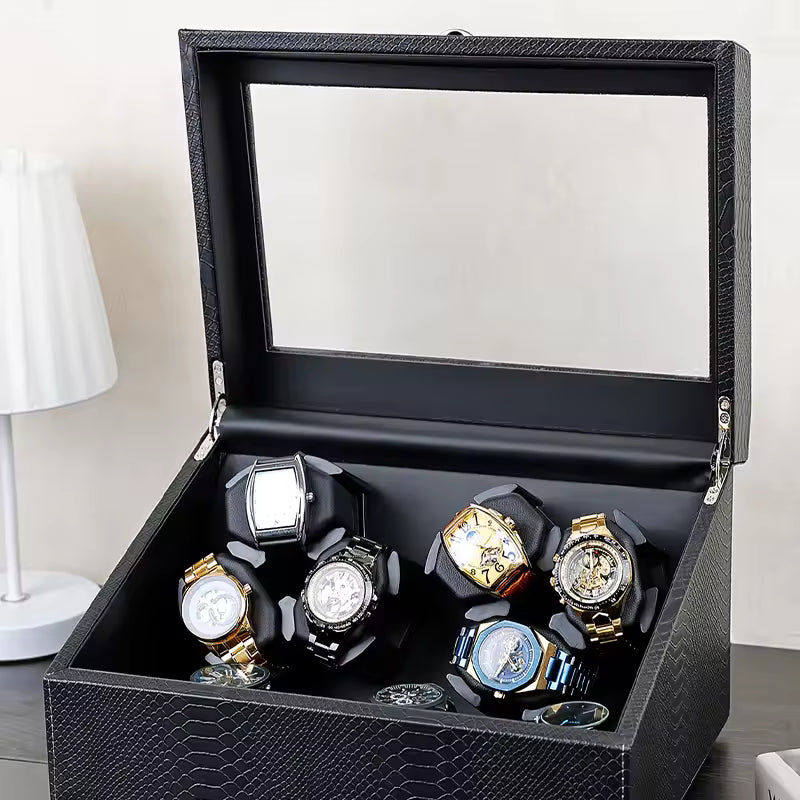
5. Turns Per Day (TPD): The Most Important Setting
Turns Per Day (TPD) refers to how many rotations a watch receives in a 24-hour period.
-
Most automatic watches need 600–900 TPD
-
Some need up to 1,200 TPD
-
Very few require more than that
A properly designed watch winder delivers enough movement to keep the watch wound — without excessive rotation.
💡 This is crucial:
More spinning ≠ better.
Over-rotation offers no benefit and low-quality winders that spin constantly can cause unnecessary wear over time.
6. Why Watch Winders Don’t “Overwind” Modern Watches
A common beginner concern is:
“Can a watch winder overwind my watch?”
For modern automatic watches, the answer is no.
Most modern movements include a slipping clutch mechanism:
-
When the mainspring is fully wound, excess tension is released
-
The rotor continues to move safely
-
No damage occurs
This is the same protection your watch uses when worn daily.

7. What’s Inside a Quality Watch Winder?
Not all watch winders are created equal. Internally, a high-quality watch winder includes:
-
A low-noise motor (important for bedrooms)
-
A precision gear system for smooth motion
-
Timed rotation cycles (on/off phases)
-
Stable power supply (AC, battery, or both)
-
Secure, well-fitted cushions to protect the case and bracelet
Cheap winders often lack proper timing logic and rotate continuously — which is unnecessary and undesirable for long-term care.
8. Why Many Collectors Use Watch Winders
Watch winders are not about convenience alone. Collectors value them because they:
-
Keep complicated watches (date, moonphase, GMT) ready to wear
-
Reduce frequent manual setting
-
Maintain lubricants evenly distributed within the movement
-
Provide safe, dust-protected storage
-
Display watches beautifully as part of a collection
For people rotating between several watches during the week, a winder becomes a practical tool, not a luxury gimmick.
9. Are Watch Winders Necessary?
Let’s be honest: not everyone needs a watch winder.
You may not need one if:
-
You own one automatic watch and wear it daily
-
Your watch has a long power reserve and simple complications
-
You don’t mind resetting the time and date
A watch winder does make sense if:
-
You rotate multiple automatic watches
-
You own watches with complex calendars
-
You value convenience and readiness
-
You want structured, protective storage
10. Choosing the Right Watch Winder (Beginner Tips)
For beginners, look for:
-
Adjustable rotation direction
-
Sensible default TPD settings
-
Quiet operation
-
Secure cushioning for different bracelet sizes
-
Build quality suitable for long-term use
Australian homes often place watch winders in bedrooms or studies, so noise level and reliability matter more than flashy features.
Many collectors start with a single or double watch winder, then expand as their collection grows.
11. Watch Winders as Part of Proper Watch Care
A watch winder should be viewed as part of an overall watch care system, alongside:
-
Watch boxes for non-automatic pieces
-
Watch rolls for travel
-
Regular servicing
-
Proper storage away from humidity and magnets
When chosen and used correctly, a watch winder simply supports the natural design of your automatic watch.

12. Where Watch Winders Fit into a Modern Collection
At Lux Watch Care, we see watch winders as practical tools designed to respect the engineering of mechanical watches, not to replace good habits.
If you’re exploring options, our curated watch winder collection is built around:
-
Controlled rotation logic
-
Quiet, stable motors
-
Clean, understated design
-
Compatibility with modern automatic movements
They’re designed to complement — not overpower — a thoughtful watch collection.
Final Thoughts: Simple Technology, Purposeful Design
Watch winders are surprisingly simple devices built around a deep understanding of mechanical watch movements. Once you understand how they work, most of the confusion disappears.
For beginners, the key takeaway is this:
👉 A watch winder doesn’t “do” anything unnatural — it simply replaces your wrist when you’re not wearing the watch.
Used correctly, it’s one of the most straightforward ways to keep automatic watches running smoothly, protected, and ready to wear.
If you’d like to explore how a well-designed watch winder fits into your own routine, you can browse our carefully selected watch winder collection and decide at your own pace — no pressure, just informed choice.