
If you own more than one automatic watch and you travel regularly, you have probably found yourself wondering whether a travel watch winder is something you genuinely need or just a clever piece of kit you do not really have to think about. It is a fair question. Travel watch winders have improved significantly over the past decade, and the better models do a respectable job. But whether one belongs in your luggage is a different matter entirely.
At Lux Watch Care, we spend a lot of time thinking about how collectors care for their timepieces, both at home and on the road. So let us work through this honestly.
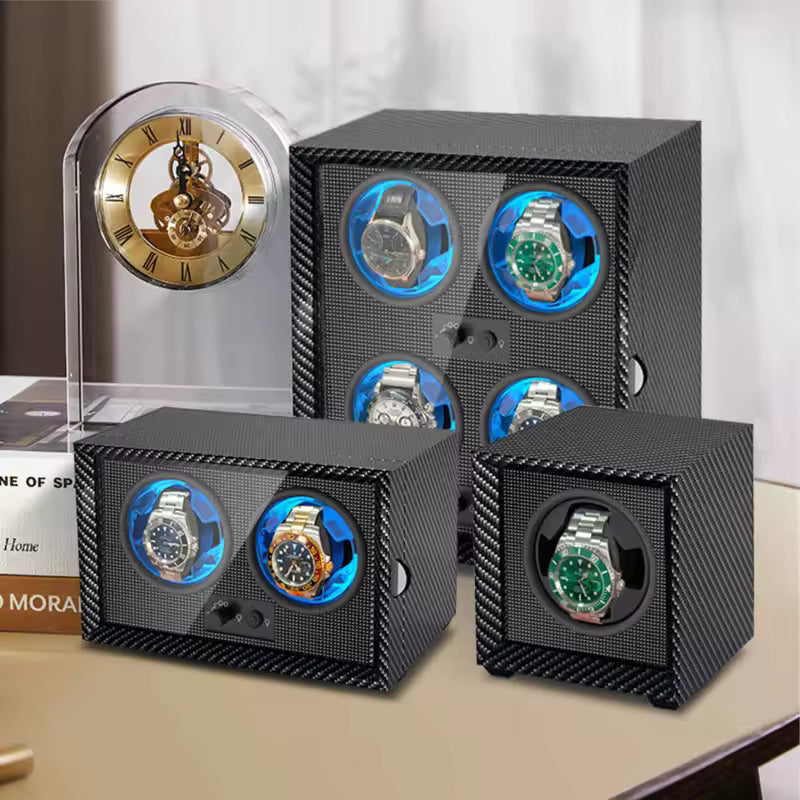
What Is a Travel Watch Winder?
A travel watch winder is a compact, portable device designed to keep automatic watches wound while you are not wearing them. Unlike the larger units designed for home use, travel models are built to be lightweight, small enough to fit in carry-on luggage, and often powered by batteries or USB so you do not have to hunt for compatible power outlets in different countries.
Most travel winders hold one or two watches and offer basic winding settings, including clockwise, counter-clockwise, and bi-directional rotation. Better models allow you to adjust the turns per day (TPD), which matters because different automatic movements have different winding requirements.
The core function is the same as a home winder: to simulate the natural movement of your wrist so the rotor inside the watch keeps the mainspring tensioned. When an automatic watch sits still for long enough, the mainspring runs down, the watch stops, and you have to reset the time and date before wearing it. If you are curious about how this whole process works mechanically, our guide on how watch winders work is worth a read.
When a Travel Watch Winder Actually Makes Sense
There are specific situations where bringing a travel watch winder is a genuinely good idea rather than unnecessary weight in your bag.
You are travelling for an extended period. If you are away for two weeks or more and rotating between several automatic watches, a travel winder means none of them will run down. You will not need to reset time, date, or any additional complications each time you switch pieces.
You own a watch with a perpetual calendar or complex complications. These movements are notoriously annoying to reset. A perpetual calendar, moon phase, or annual calendar watch can take considerable effort to bring back to the correct display after it has stopped. For these pieces specifically, a travel winder is worth the extra luggage space.
You are a collector who brings three or more watches on a trip. If you are the type who plans outfits around different watches, travelling with a winder means every piece stays ready. You will not arrive at a dinner in Sydney or a business meeting in Singapore only to find the watch you wanted to wear has stopped.
You travel frequently for work. Frequent flyers who cross multiple time zones regularly benefit from automatic watches staying accurate without constant manual resetting. A travel winder removes that friction entirely.
When a Travel Watch Winder Probably Does Not Make Sense
This is where the honest part comes in. For many collectors, a travel watch winder is more luxury than necessity.
You are taking one or two watches on a short trip. If you are away for a long weekend or a week, and you plan to wear the same watch most days, it will stay wound simply from the movement of your wrist. There is no need for a winder at all.
You have standard automatic watches without complex complications. Resetting the time and date takes thirty seconds. Unless that genuinely bothers you, a winder is not solving a real problem.
Your priority is keeping watches safe in transit. A travel winder is a winding device, not primarily a protection device. If your main concern is preventing scratches and keeping things organised in your luggage, a well-made leather watch roll does a better job with less bulk and less complexity.
You are watching your luggage weight. Even compact travel winders add meaningful weight compared to a watch roll. If you travel light or fly carry-on only, that weight adds up.
Travel Watch Winder vs. Leather Watch Roll: A Practical Comparison
For most travellers who take watches with them, the choice is not really between a travel winder and nothing. It is between a travel winder and a quality leather watch roll or travel case.
A leather travel watch roll is compact, lightweight, and purpose-built for safe transport. The padded individual slots cushion each watch and keep pieces from touching each other. A good one rolls up neatly and fits into a corner of your carry-on or overnight bag without any fuss.
Watch rolls do not keep your automatic watches wound - that is not what they are designed to do. But for a trip of a week or less, with watches you wear regularly, that simply is not an issue. A watch you wear throughout the day will stay fully wound from normal wrist movement alone.
Travel winders, on the other hand, add weight and complexity. They need power (either batteries or a USB adapter), they require careful packing so they do not shift during transit, and they add cost. For most weekend or short-haul trips, the benefits do not outweigh these trade-offs.
Our recommendation: use a leather watch roll for travel, and let a quality home winder do the heavy work on the pieces staying behind. Our guide on why watch rolls are perfect for travellers goes into more detail on why this combination works so well.
What to Look for in a Travel Watch Winder (If You Decide You Need One)
If you have weighed the options and a travel watch winder makes sense for your situation, here is what to look for.
Quiet motor. A winder that hums loudly through the night in a hotel room is not practical. Look for models with Mabuchi motors or similar quiet mechanisms that will not disturb your sleep.
Dual power options. The best travel winders run on both batteries (typically AA) and a USB or AC adapter. This eliminates the stress of finding the right voltage or the right plug when you are abroad.
Adjustable TPD settings. Different watches need different turns per day. A model with clockwise, counter-clockwise, and bi-directional settings - and ideally an adjustable TPD range - gives you flexibility across different pieces in your collection. For guidance on getting those settings right, our breakdown of watch winder settings and winding directions is a good starting point.
Compact dimensions. It should fit comfortably in carry-on luggage or a medium-sized bag without dominating the space. Anything over 20cm in any dimension starts to become impractical for travel.
Protective interior. Look for a soft lining - suede, microfibre, or felt - that cushions the watch and prevents the crystal or case from being scratched by the winding mechanism itself.
Secure closure. The last thing you want is a winder that pops open in your bag and sends your watch tumbling. A firm zip or clasp is worth paying attention to.
The Case for Using Both
The most practical setup for a serious collector who travels regularly is not an either/or choice. It is using both tools for what each does best.
Keep a proper winder at home for the pieces in your rotation that you are not taking with you. If you own four watches and you are travelling with one or two, the others benefit from staying wound so they are ready when you return. Our single-slot automatic watch winder is a quiet, reliable option for exactly this purpose.
For travel, pack a quality leather watch roll. It keeps your pieces safe, organised, and easy to access without the added bulk of a winding mechanism. Our vintage genuine leather multi-slot watch roll travel case is a popular choice among collectors who want genuine leather construction with enough slots to carry several pieces comfortably.
For extended trips where you genuinely need a winder, our 2-slot automatic watch winder offers a compact footprint and supports two watches simultaneously - practical for a collector rotating between a dress watch and a sports piece throughout a longer trip.

The Honest Verdict
A travel watch winder is a good investment for a specific type of collector: someone who travels for extended periods, owns watches with complex complications that are tedious to reset, and takes multiple automatic pieces on every trip.
For everyone else, a quality leather watch roll is the smarter travel companion. It is lighter, simpler, and does the most important job - keeping your watches safe - without the extra weight, cost, and power dependency of a winding device.
At Lux Watch Care, we carry both. Our range of premium watch winders is built for collectors who want their pieces kept in motion, and our leather watch rolls are designed for those who prefer a cleaner, more portable solution on the road.
If you are not sure which option fits your collection and your travel style, we are happy to help you work it out.
Get in touch with us and we can point you towards the right solution for how you travel and how you collect.
Frequently Asked Questions
Do I need a watch winder when travelling with automatic watches?
Not necessarily. If you plan to wear your watch regularly throughout your trip, your natural wrist movement will keep it wound. A travel watch winder is most useful for extended trips where you are rotating between several automatic pieces and cannot wear each one regularly enough to keep it running.
Can I take a watch winder on a plane in carry-on luggage?
Generally yes. Most travel watch winders are permitted as carry-on items. If the winder uses lithium batteries, check the airline's battery size restrictions beforehand, as rules vary. Battery-powered models running on standard AA batteries are typically straightforward to carry through security.
What is the difference between a travel watch winder and a watch roll?
A travel watch winder is an electronic device that rotates your watch to simulate wrist movement, keeping the movement wound. A watch roll is a padded leather storage case designed to protect and organise watches during transport. Watch rolls do not wind watches, but they are lighter, simpler, and sufficient for most travellers.
How many turns per day does a travel watch winder need to provide?
Most automatic watches wind adequately at around 650 to 1,800 turns per day, depending on the movement. Many modern movements operate well at approximately 1,500 TPD. Check your watch manufacturer's specifications for the recommended TPD for your specific movement.
Is it safe to leave an automatic watch in a travel winder overnight in a hotel room?
Yes, provided the winder has a quiet motor and the settings are appropriate for your watch's movement. A winder with a Mabuchi motor or similar whisper-quiet mechanism is unlikely to disturb sleep and will not harm the watch when set to the correct TPD and rotation direction.
Should I use a travel winder for a Rolex, Omega, or other high-end automatic watch?
Most quality automatic watches, including those from major Swiss brands, are compatible with watch winders. The key is to use the correct settings for the specific movement. Our guide on whether watch winders are safe for automatic watches covers this in more detail.
Is a leather watch roll or a travel watch winder a better gift for a watch enthusiast?
For most watch lovers, a quality leather watch roll is the more practical and universally appreciated gift. It suits collectors of all levels and works for any watch type. A travel winder makes a more targeted gift for someone who is known to travel frequently with multiple automatic pieces and already owns several watches with complex complications.